EdTech · Prototype
SM-2
spaced repetition + conversational AI
RecallMate
AI-assisted spaced repetition with conversational tutoring
UX research
I’m Sina Dehesh, a UX researcher and behavioral scientist in Milan. I run the research that tells a team what users actually do and why: interviews, usability tests, surveys and controlled experiments. I’ve run more than 240 interviews and usability tests and a within-subjects experiment with 96 participants, and I turn what I find into decisions the team can test.
Hiring a UX researcher? I’m open to in-house and contract roles in Milan, Turin or remote, as well as research projects. Email me about a role or see my LinkedIn.
Services
From a first round of interviews to an experiment that settles an argument.
M.Sc. Applied Experimental Psychological Sciences, University of Milano-Bicocca. Two-year master's, 120 ECTS, taught in English.
Methods
| Method | The question it answers | Where I used it |
|---|---|---|
| Multi-round interviews with thematic coding | What do users need, in their own words? | RecallMate |
| Usability tests and pilot studies | Where do people get stuck? | RecallMate |
| Within-subjects experiment (N = 96) | Does what people see on screen change how they behave? | Automated Interview Simulation Study |
| Field test of a new interaction | Will users actually do it more, and enjoy it? | Passway |
| Competitive benchmarking | What do the alternatives do better, and where is the gap? | RecallMate |
| A testable hypothesis for each design change | Does a short game before a long test raise completion? | OopsCupid |
| UX research | Market research | |
|---|---|---|
| Core question | Can people use it, and does it fit their lives? | Who will buy, how many, and at what price? |
| Unit of study | A person trying to get something done | A market, a segment or a brand |
| Typical methods | Interviews, usability tests, experiments, analytics | Surveys, panels, sizing, segmentation, tracking |
| What it changes | Flows, features and the product roadmap | Positioning, pricing and go-to-market |
Many questions sit in between, such as why people try a product once and never return. That is where I work most: user research with a behavioral lens.
Proof
SM-2
spaced repetition + conversational AI
AI-assisted spaced repetition with conversational tutoring
p = .009
N = 96 controlled experiment
How what candidates see on screen shapes their behavior
10 × 6
topics × university programs
Curriculum-gap tracker built on a two-source data model
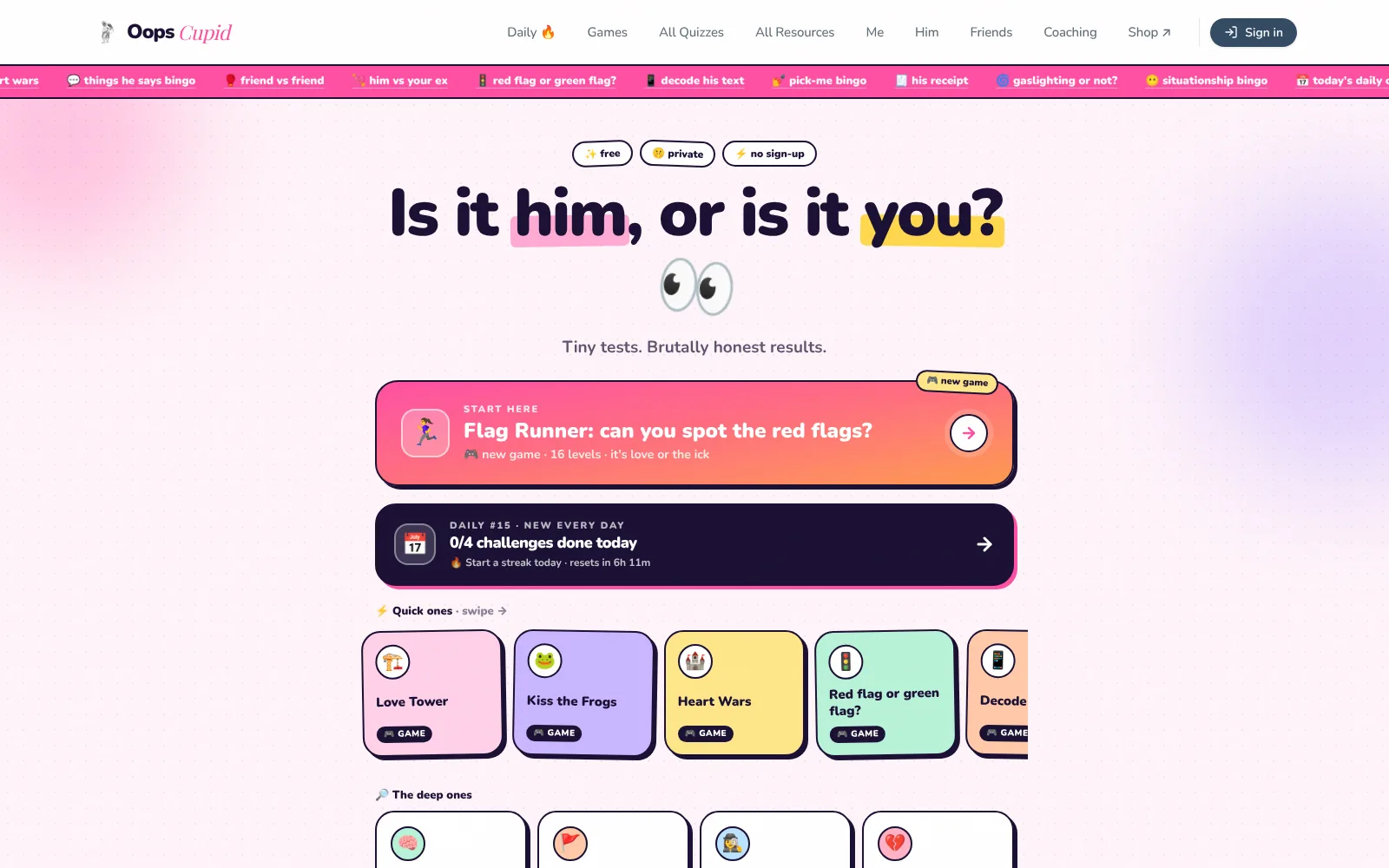 Consumer app · Live
Psychometric relationship assessments with an LLM profiling layer
15 — free psychological tests, zero sign-up
Writing
Research methods
What does a UX researcher do? The job step by step, which UX research methods answer which question, how many users you need, and when to hire one.
7 min read
Research methods
Within-subjects design in UX research: when repeated measures beat A/B tests, how to handle order effects, and how to run a repeated-measures ANOVA properly.
6 min read
Research methods
Thematic analysis with ChatGPT or another LLM, done rigorously: where AI helps in Braun and Clarke's six phases, where it fails, and a workflow you can verify.
5 min read
Research methods
How to analyze interview data statistically with binary logistic regression: codable interview design, the outcome, sample size per predictor and odds ratios.
6 min read
Research methods
Kano vs MoSCoW for AI products: what each feature prioritization framework answers, why AI features drift between Kano categories, and how to combine both.
5 min read
AI products
An AI interview experiment (N = 96): candidates were more expressive with an AI avatar than when they saw themselves. The design, results, limits and lessons.
6 min read
Related expertise
Behavioral science, consumer psychology, consumer behavior, UX research and market insights overlap. Each page shows the part people usually search for.
FAQ
A UX researcher finds out what users need, what they actually do and where a product fails them, using interviews, usability tests, surveys, analytics and experiments, and turns the findings into decisions a team can act on. I run the whole cycle: plan the study, recruit participants, run the sessions, analyze them and help decide what changes first.
See RecallMate
It depends on the question. To find problems in one round of qualitative testing, a small group of around five users usually surfaces most of the big issues, which is why several small rounds beat one large one (Nielsen, 2000). To measure a difference, such as whether design A beats design B, you need many more participants and a sample size worked out in advance.
A UX researcher studies users and tests ideas; a UX designer designs the flows and the interface. The roles work closely and overlap. I’m a researcher and behavioral scientist: I plan and run the research and design the behavior change, and I work with designers and engineers who own the interface and the code.
See RecallMate, Passway
Yes. Interviews and moderated usability tests work well remotely, with screen sharing and recordings, and I run them in English, Italian, Persian or German. In-person sessions in Milan help when context matters, for example when you need to watch someone use a product where they really use it.
(Contact)
Based in Milan, Italy · Available in Milan, Turin, across Europe and remotely · English, Italian, Persian, German · LinkedIn