Consumer app · Pre-launch
Costly: Doomscrolling that costs real money — until you walk it back
- Role
- Founder
- Client / context
- Costly
- Headline figure
- 80% — of every loss earned back by walking it off
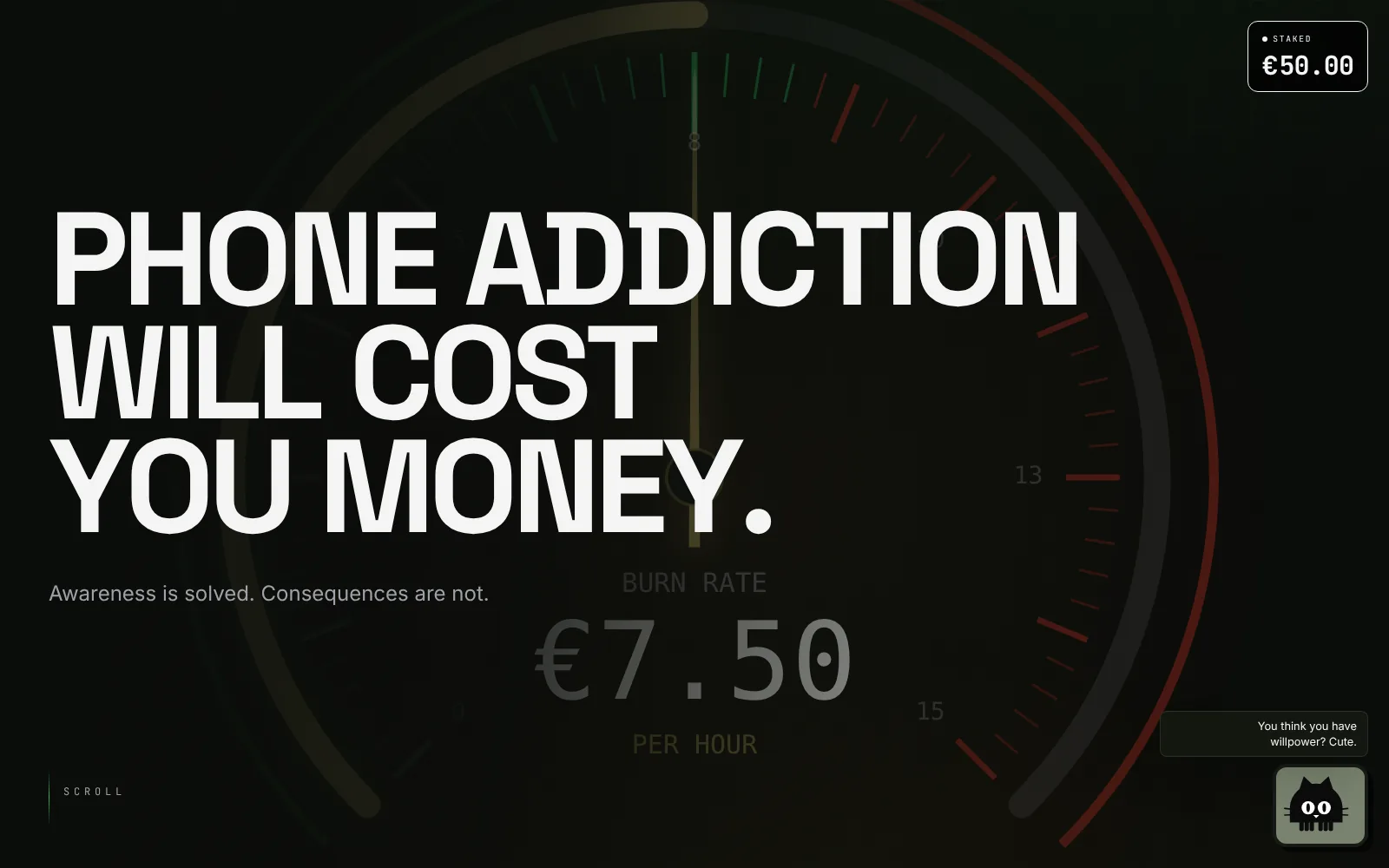
Costly is a habit-reversal app that charges real money for every minute of doomscrolling, at the hourly rate you set for your own time — then lets you earn 80% of it back by walking it off within 24 hours. A self-priced commitment contract stops you deleting it when it starts to hurt.
Executive impact summary
- Problem
- App blockers rely on soft friction, so people switch them off — competitor reviews are full of "I just turn it off." Commitment-contract apps work, but make users define and track a goal first.
- Psychology used
- Real stakes and loss aversion (money held per minute scrolled), losses framed against a five-tier ladder of things the user actually wants, redemption through exercise (2 minutes walked per minute scrolled), and precommitment through a self-priced deletion fee.
- Methods
- Loss aversion and precommitment design · Real-money holds through Stripe · Android companion app · Walking detection to earn money back
- Outcome
- Built in June–July 2026: the full flow of holding money and giving it back through Stripe, and an Android companion app with a live meter on screen. No users yet — the first live loop on real hardware is the next milestone.
Investment
Costly is raising
Accelerator programme + pre-seed
Zero users. No charge has moved yet. The system is built end to end; the first live loop on real hardware is the next milestone.
What the round funds: the 12-week plan
- Weeks 1–4Step 1: Harden, deploy and tune detection → first live loop on real hardware
- Weeks 5–8Step 2: 30–50 user alpha on real cards at small stakes → retention and redemption data; legal opinion on the contract terms
- Weeks 9–12Step 3: Randomized three-arm study — awareness vs. soft friction vs. stakes → effect size
How success is measured
- Primary: daily minutes in targeted apps, week 4 vs. baseline
- Health: redemption rate — the share of holds walked off
Use of funds, in priority order
- 01Legal & compliance — EU unfair-terms review of the breach fee and the 14-day withdrawal question
- 02Alpha cohort — recruitment and a reimbursement pool so real cards can run ethically at small stakes
- 03Part-time Android contractor — detection tuning and device-matrix testing, the riskiest technical surface
- 04The study — instrumentation, incentives and analysis
First thousand users
People who already paid for a blocker and relapsed: proven willingness to pay, proven dissatisfaction with soft friction.
The ask
Beyond capital: payments and regulatory introductions, and time with people who have shipped consumer products that charge cards on an automated trigger.
Interactive
See how Costly works
€0.0000
Priced at €15.00/hour against the goal. The meter has no zero state — that is the entire argument.
Feedback only changes behavior when it carries a consequence. Costly makes the consequence real, prices it against the things you actually want, and lets you walk most of it back.
Trade-offs that shaped Costly
- Scrolling is detected from screen time and phone movement instead of reading the screen, so the app stays within Google Play's rules, at the cost of tuning it on each phone.
- Two Stripe PaymentIntents per session — 20% captured, 80% held for 24 hours — because Stripe cannot partially capture a payment and keep the rest on hold.
- The user sets the deletion fee (€0–€1000, zero allowed) and a fixed 7- or 30-day term, so the contract is self-priced rather than an imposed penalty.
- If the redemption rate comes back low, Costly is a punishment app and needs rebalancing — the alpha is designed to find that out early.
Decision log
Each decision, the hypothesis behind it, how it was tested, and what came of it.
| Challenge | Hypothesis | Method | Outcome |
|---|---|---|---|
| Screen-time feedback rarely changes behavior. | Feedback changes behavior only when it carries a consequence. | Real-money meter at a self-set hourly rate, framed against a five-tier ladder of wanted products. | Per-second live meter overlaid on the target app. |
| Pure punishment drives uninstalls. | A redemption path keeps stakes real but fair. | 20/80 split: 80% held for 24 hours and released on a verified walking goal (Health Connect). | Two-PaymentIntent session lifecycle with an expiry sweep. |
| People delete the app when it hurts. | Precommitment beats willpower. | Self-priced deletion fee and lock-in term, enforced by a heartbeat dead man's switch. | Commitment contract signed at onboarding; breach sweep scaffolded. |
| Is the effect causal, or just awareness? | Stakes cut targeted-app minutes more than awareness or soft friction. | Planned randomized three-arm study: awareness vs. soft friction vs. stakes. | Scheduled for weeks 9–12, after a 30–50 user alpha. |
Key features
- Real-money per-minute meter
- Self-set hourly rate
- Five-tier ladder of wanted products
- Walk-it-off redemption via Health Connect
- Commitment contract with dead man's switch
- Live overlay meter on Android
Loss Aversion · Commitment Devices · Behavioral Friction · Habit Reversal · Precommitment · Digital Wellbeing
Writing that draws on Costly
Consumer psychology
Pricing Page Psychology: Defaults, Decoys and One Clear Next Step
Pricing page psychology that holds up: defaults, anchors, the decoy effect and choice overload, plus a checklist for choice architecture you can defend.
6 min read
Consumer psychology
Persuasion or Dark Pattern? A Five-Question Test Before You Ship
Dark patterns vs persuasive design: a five-question test to run before you ship, applied to real products, plus the EU and UK rules that already draw the line.
6 min read
Behavioral science
What Does a Behavioral Scientist Do? The Job, Explained
What does a behavioral scientist do? Where they work, how a project runs from one behavior to a test, the frameworks and skills, and what nudge evidence shows.
7 min read
(Contact)
Need work like Costly on your team?
Based in Milan, Italy · Available in Milan, Turin, across Europe and remotely · English, Italian, Persian, German · LinkedIn