Game · In development
Pukytoon: A feed of games anyone can make, share and play
- Role
- Founder
- Client / context
- Own product
- Headline figure
- 1 link — turns a Claude, Gemini or Kimi game into a card in the feed
Pukytoon is still in development, so it isn’t open to play yet. If you’d like to know more, or to fund it, email me.
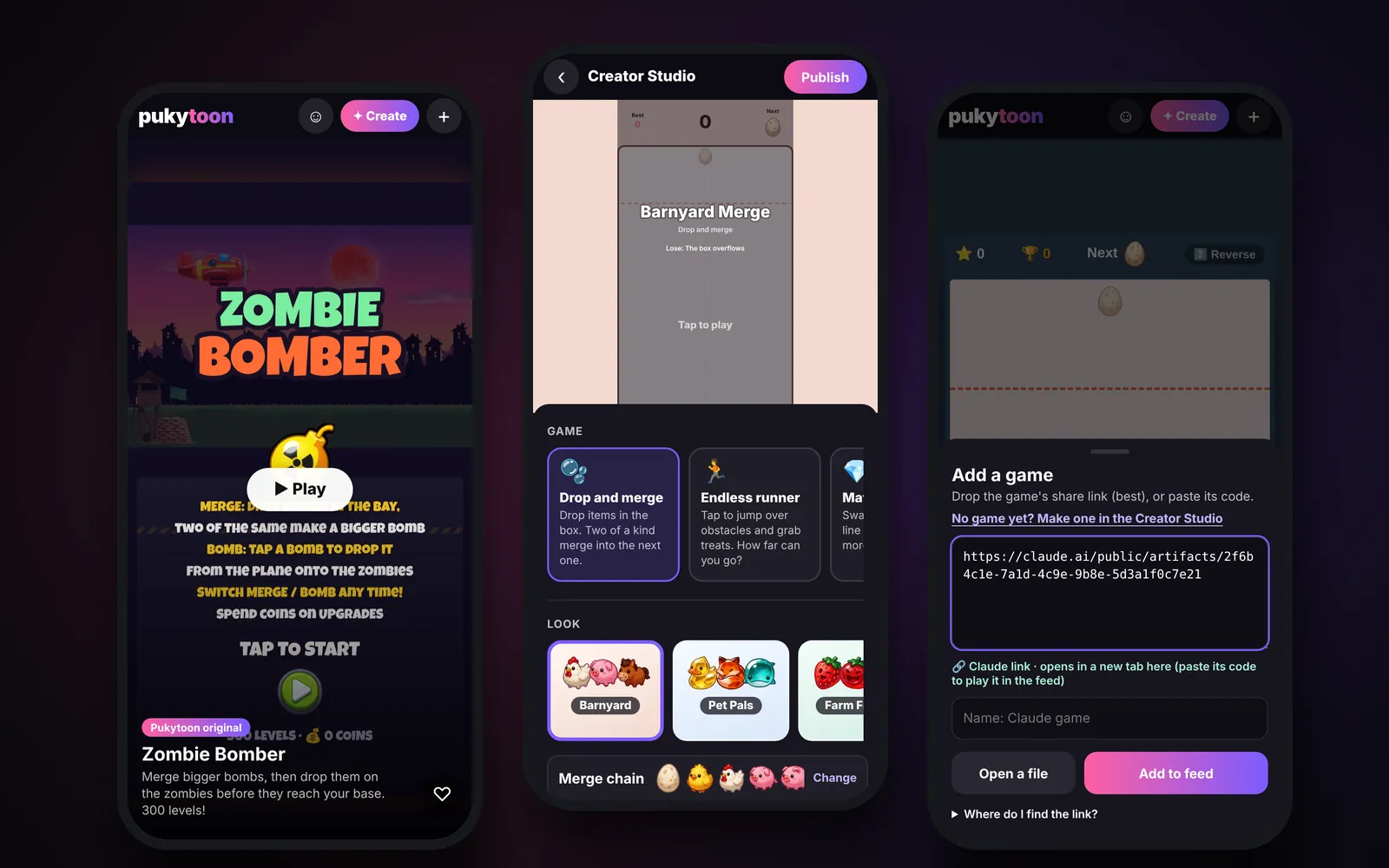
Pukytoon, still in development, is a feed of games you swipe through like short videos, and anyone can add to it. Make a game in the Creator Studio with no code — four game types, six looks, 74 pictures, your own rules, so hundreds of different games — or copy the link of a game you made as a Claude artifact or with Gemini or Kimi and paste it in: it becomes a card in the feed. Sign in to share your games with everyone, like other people's, send a game to a friend with one link, or make your own version of someone else's. Making videos became something everyone can do; I believe making games will go the same way, and that the social platforms of the future will be gamified.
Executive impact summary
- Problem
- People make small games with AI chatbots every day, but they stay stuck behind share links that nobody browses, and making a game from scratch is still far harder than making a video.
- Psychology used
- Feed-style browsing cuts the cost of trying a game to one swipe; a no-code Creator Studio turns players into makers; pasting a link turns an AI-made artifact into a game in the feed; likes, share links and remixing make every game social.
- Methods
- Feed design: one swipe to try a game · No-code Creator Studio · Paste a link: Claude artifacts, Gemini, Kimi · Accounts, likes, share links and remixing · Android app and web
- Outcome
- In development. The swipe feed, the Creator Studio, adding games by link or code, and a shared feed with accounts, likes, share links, reports and remixing work in a web build and an Android test build.
Why it matters
Everyone makes videos now. Next, everyone makes games.
Every medium opened up the same way. Writing, photos, music and video were once made by specialists for everyone else; then the tools got easy, a place to share appeared, and making became something people do for each other. Games are the last big medium still made mostly by specialists, because even a small game needs rules, pictures, sound and code.
AI has started to change that: anyone can describe a game to Claude, Gemini or Kimi and play it a minute later. But those games end at a share link nobody browses. What’s missing isn’t a better tool. It’s the social part: a feed where games get seen, and people who play them, answer them and make their own.
That’s why Pukytoon is built around people as much as games. When anyone can make a game, games become messages, gifts, jokes and replies — a new way for people to spend time together.
- 01
A game becomes a message
When a game takes minutes to make, you can make one for a single person: a birthday, an inside joke, a quiz only your class can pass. Its value is who made it and who it’s for, not how polished it is.
- 02
From player to maker, one small step at a time
In most communities, most people only watch. So every step is small: swipe to play, tap to like, share with one link, make your own version of someone’s game, then make one from scratch.
- 03
Remixing is how makers talk
Making your own version of someone’s game is a reply: I liked this, here’s mine. Starting from a game that already works is also the gentlest way to learn how games are made.
- 04
Credit travels with every game
Every shared game carries its maker’s name and @handle. Among makers, credit is the currency: it turns a copy into a conversation and a run of games into a reputation.
- 05
An audience is the reason to make a second game
Likes tell a maker that someone played and enjoyed their game. Following makers, which comes next, will gather each maker’s games in one place, so every new one reaches the people who liked the last.
- 06
Playing together, even apart
One link per game means a game travels through the group chats people already use. Playing a game a friend made is a way to spend time with them when you can’t be in the same place.
- 07
Games about everyone’s lives
When only studios make games, games reflect a narrow set of people and tastes. When anyone can make one, there can be games in every language, about every town, school and family.
- 08
Safety keeps the room open
Beginners only share when they trust the room. Every pasted game runs sealed off from the app and the other games, people can report and hide what they don’t want, and until the checks for shared code are ready, only Studio games and Claude, Gemini or Kimi links can be shared with everyone.
Trade-offs that shaped Pukytoon
- Claude, Gemini and Kimi don't let other apps embed their pages, so a link game plays full screen in the app's own view (a new tab in the web version); pasting the game's code plays it right in the feed.
- A Creator Studio game is saved as a few hundred bytes of data — the game type, settings, look and rules — so it loads instantly, works offline and can be shared and remixed safely.
- Every pasted game runs sealed off from the app and from the other games, and only Studio games and links to Claude, Gemini or Kimi can be shared with everyone until the safety checks for shared code are ready.
Decision log
Each decision, the hypothesis behind it, how it was tested, and what came of it.
| Challenge | Hypothesis | Method | Outcome |
|---|---|---|---|
| AI-made games are scattered across share links. | A swipeable feed makes trying a game as cheap as watching a clip. | One game per screen with video-style snapping, each game waiting under its cover. | A feed that plays built-in games, pasted code and AI share links. |
| Making a game is still much harder than making a video. | If making a game means choosing and tuning instead of coding, players become creators. | A Creator Studio: pick a game type and a look, tune it while a live preview plays, set how to win and lose, publish. | Drop-and-merge, endless runner, match-3 and whack-a-mole games in six looks, made without code. |
| A game nobody can find or share stays a private toy. | Names, likes, share links and remixing make each game a reason to come back and invite someone. | Email sign-in with no password, a shared feed, likes, a share link for every game, Make your own version, reports and hiding. | Shared games carry their creator's name and @handle; following creators, community mechanics and an asset library come next. |
Key features
- Swipe feed, one game per screen
- Creator Studio: four game types, six looks, 74 pictures, no code
- Your own rules for winning and losing
- Add a game by pasting a Claude, Gemini or Kimi link, or its code
- Share with everyone, likes and one-link sharing
- Make your own version of any shared Studio game
- Android app and web
Feed Design · AI-generated Games · Claude Artifacts · No-code Game Maker · Creator Tools · Gamified Social Platforms · Democratization of Game Development · Remix Culture
Writing that draws on Pukytoon
Creativity & games
The Democratization of Game Development: Anyone Can Make a Game
The democratization of game development, explained: why making games is following making videos, what AI changes, and why the social side decides who joins.
6 min read
Creativity & games
The Social Side of Making Games: Remix, Credit, Followers, Play
Why making games is turning social: games as messages, the ladder from player to maker, remixing, credit, followers and shared play, and how to design for it.
8 min read
Creativity & games
Pukytoon: Why I'm Building a Feed of Games Anyone Can Make
Pukytoon is a feed of games anyone can make, share and play, now in development. Why I'm building it, the design decisions so far, and what comes next.
5 min read
(Contact)
Want to know more about Pukytoon, or to fund it? Email me.
Based in Milan, Italy · Available in Milan, Turin, across Europe and remotely · English, Italian, Persian, German · LinkedIn